Select Page

The HPDs you already have are now a path into WELL
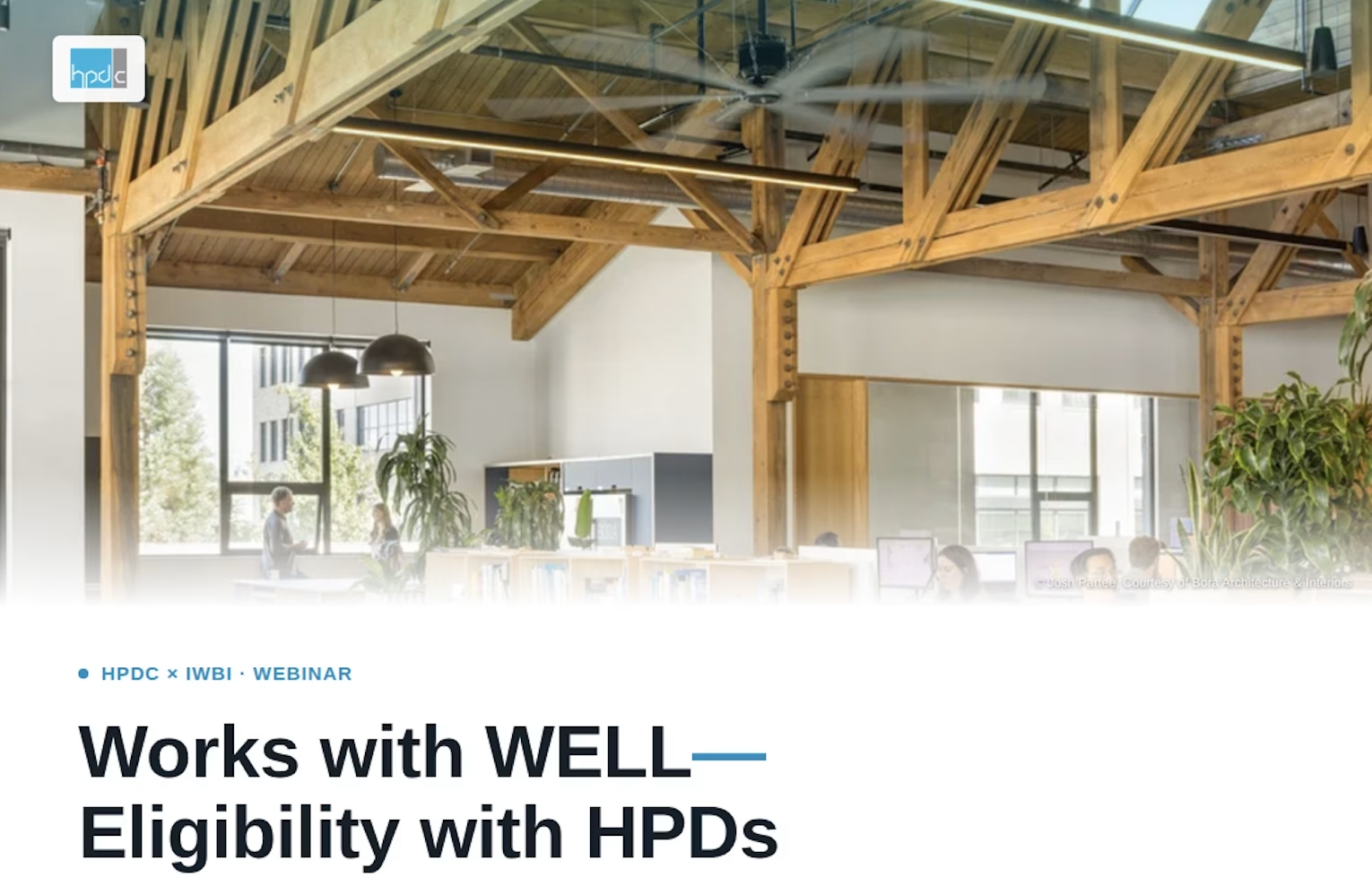
The Works with WELL pre-check is live in HPD Builder. It reads the HPDs you have already published and tells you which WELL features your products align with — no second submission, no re-entered data.

On August 18, HPDC and the International WELL Building Institute hosted a joint session on something that went live earlier this month: a Works with WELL pre-check inside HPD Builder.

The short version is that a manufacturer who has already published an HPD can now open it, run a pre-check, and find out which WELL features that product aligns with. Nothing is re-entered. Nothing is assembled a second time.

Why this matters

More than 1,000 manufacturers have voluntarily published over 18,000 HPDs covering more than 40,000 products. That is a large body of completed disclosure work.

Until now, using it to gain recognition in another program meant starting over — a new form, a new package, the same underlying facts entered again. The cost of transparency was being paid repeatedly, by the companies that had already done the most.

That is the problem this collaboration removes. As Wendy Vittori put it on the call, the goal has always been to make disclosure so affordable and so straightforward that every product can have an HPD and every project team can use it. Work that only counts once works against that.

The collaboration has been a long time coming. Wendy and IWBI’s Rodolfo Perez noted on the call that the two organizations first discussed doing something concrete around 2018 and 2019, and that HPDC and IWBI have been in conversation for essentially the whole of IWBI’s existence. This is the first time it has taken the form of a shared technical process rather than mutual recognition.

What Works with WELL is — and what it is not

This is worth stating plainly, because it is the question we get most.

Works with WELL is a mark, not a product certification. IWBI does not operate a testing laboratory and is not a label competing with the certifiers already in this space. What the mark does is show how a product contributes to WELL strategies — the chemical restrictions, the emissions thresholds, and the disclosure requirements already written into the WELL Building Standard.

Rodolfo made the underlying logic hard to argue with: the first word in HPDC is Health. The first concept in WELL is health. Both organizations are working on the same problem from different ends.

For scale: WELL is in use in more than 12 countries, across roughly six billion square feet.

What the pre-check actually checks

Milla Marcano, HPDC’s Technical Manager, demonstrated it live. Inside HPD Builder, the tab that used to read “LEED and program pre-checks” now reads LEED, WELL and program pre-checks, with a Works with WELL tab alongside the others.

It evaluates your HPD data against the five WELL v2 Materials features that bear on material health:

  • X01, Fundamental Material Precautions — the precondition covering asbestos, mercury, and lead, with lead handled separately for electronics, paints, and plumbing products.
  • X05, Enhanced Material Restrictions — which branches by product category.
  • X06, VOC Restrictions — covering both content and emissions.
  • X07, Materials Transparency — with three paths: a complete HPD at the 1,000 ppm threshold, a complete HPD at 100 ppm, and a third-party verified HPD.
  • X08, Materials Optimization — which looks at ingredients and at certifications relating to material health performance.

Each feature reports alignment with the reasoning attached, so a product that does not align comes back with the specific cause — a substance on a screening list, a category that does not apply — rather than a bare no. Each card links to the underlying feature language in the WELL Building Standard.

One detail worth knowing: a complete, published HPD already aligns you with at least one WELL feature before you check anything else. The disclosure itself is the first contribution.

Where the data goes

The pre-check result is not part of your HPD. It does not appear in the report and it does not render in the PDF.

It is a separate data set, shared with IWBI through HPDC’s API. IWBI uses it to identify manufacturers whose products are candidates for the program. Designations then come back to us, and products that hold one are marked in the HPD Public Repository and surfaced in the dashboard available to HPDC members.

That designation also reaches HPDC’s API data partners — the workflow tools and product libraries where project teams actually specify. Andre Baros of Acelab raised this on the call, and it is the part manufacturers most often miss: publishing does not just place a document in the Repository, it moves the result to where specification decisions get made.

If your HPD covers multiple products, use the SKU field. HPDC’s grouping guidelines let one HPD represent several products where they share at least 90 percent of their inventory, hold common certifications, and are functionally similar. Listing the individual product identifiers is what tells IWBI the alignment covers all of them.

How to get started today

  • Open your product in HPD Builder and go to LEED, WELL and program pre-checks.
  • Select the Works with WELL tab and run the pre-checks that apply to your product.
  • Read the feedback on any feature that does not align. Much of it is addressable.
  • Publish. If the HPD is already published, publish again — that updates the record and sends the pre-check data.
  • Contact IWBI to enroll.

On timing: because the material health claims have already been checked by the pre-check, the remaining review at IWBI is expected to be considerably faster than the program’s normal path.

What comes next

More is being added — an option to run every pre-check at once, clearer reporting on features a product is not eligible for, and a prompt before publication reminding you to run your pre-checks.

If you have not looked at the pre-checks in HPD Builder recently, this is a good moment. There are now three tabs of them covering different programs, and they run together. Alignment work you do for one program is visible against the others in the same place.

Watch the session: https://www.youtube.com/watch?v=4rESfyMI8BU

Milla’s demo begins at about 19 minutes, and the Q&A runs the final twenty.
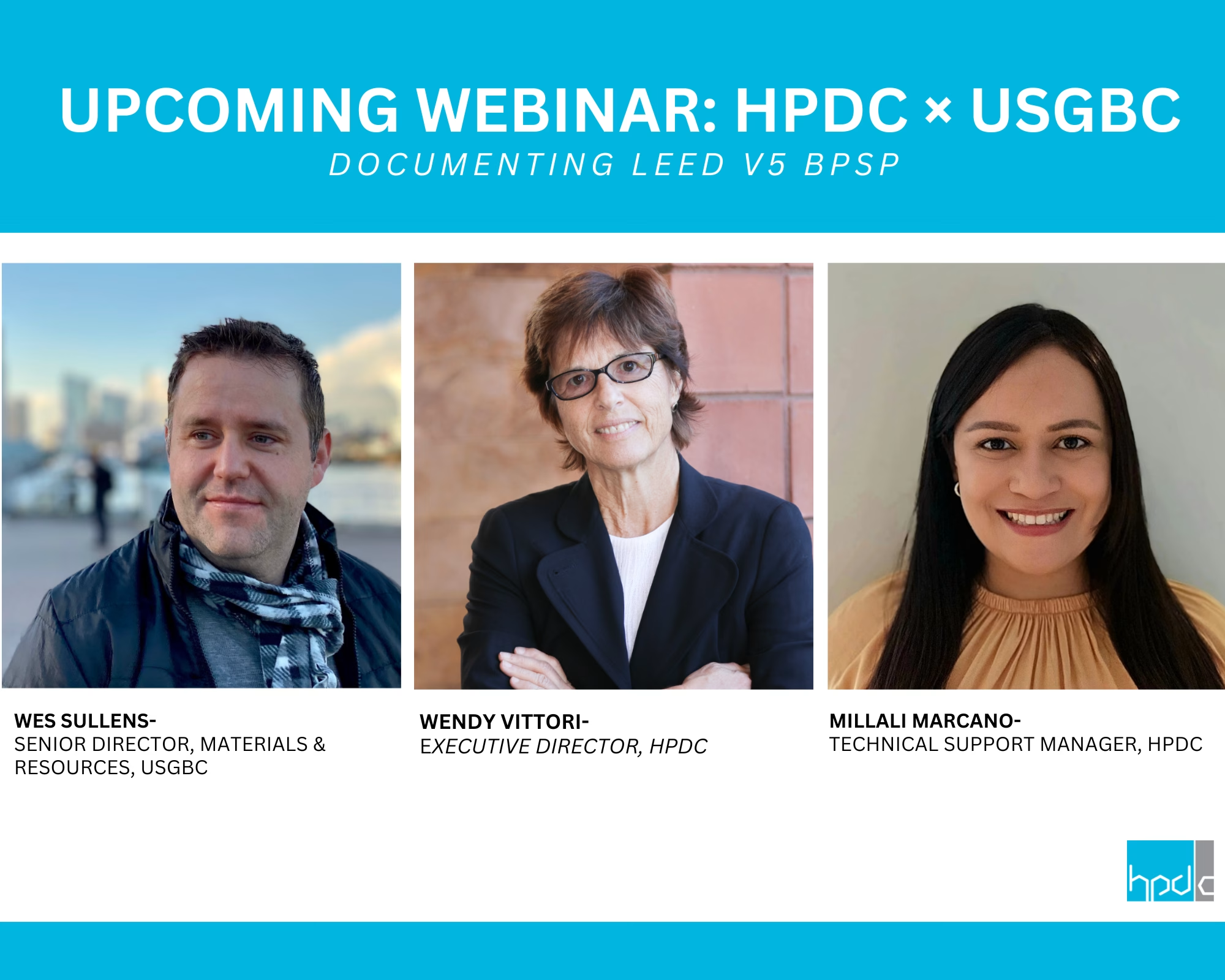
Upcoming Webinar: Documenting LEED v5 BPSP — HPDC × USGBC

Documenting LEED v5 BPSP — HPDC × USGBC Webinar

LEED v5 is reshaping how the industry thinks about Material Health.

It is no longer treated as a standalone credit. Instead, it is now one of five integrated criteria areas within Building Product Selection & Procurement (BPSP)—alongside Climate, Ecosystem, Social Health & Equity, and Circular Economy.

This shift reflects a more realistic, holistic approach to material decision-making in architecture and design. However, it also significantly increases the complexity of documentation and reporting for both manufacturers and project teams.

To address this, the HPDC Foundation Materials ToolSuite was developed to help bridge the gap between product data and project documentation needs.


Webinar Overview

Join us on Wednesday, June 17th from 12:00–1:00 PM ET (9:00–10:00 AM PT) on Microsoft Teams for a free, one-hour joint webinar hosted by the U.S. Green Building Council and HPDC.

During this session, we will explore how the LEED v5 BPSP framework works in practice, where Material Health fits within the broader structure, and how new digital tools are helping streamline the path from manufacturer data to project-ready documentation.

We will also introduce HPDC’s BPSP Product Scoring PreCheck, a new capability within the HPD Builder that helps translate existing product information into usable BPSP scoring insights for project teams.


What You’ll Learn

By the end of this session, participants will understand:

  • How the LEED v5 BPSP credit system is structured and why it represents a shift in Material Health evaluation
  • How HPDC’s Materials ToolSuite transforms existing product data into documentation-ready outputs for BPSP
  • A live demonstration of the BPSP Product Scoring PreCheck inside HPD Builder
  • Practical steps manufacturers can take today to begin aligning their products with BPSP requirements
  • How project teams and specifiers will interact with BPSP data as it becomes available through the public Repository


Featured Speakers

  • Wes Sullens — Senior Director, Materials & Resources, USGBC
  • Wendy Vittori — Executive Director, HPDC 
  • Millali Marcano — Technical Manager, HPDC


Who Should Attend

This session is designed for:

  • Manufacturers working with HPDs or sustainability disclosures
  • Architects and designers involved in material selection
  • Sustainability and ESG professionals
  • LEED consultants and project teams
  • Anyone working with LEED v5 documentation or product transparency

Introducing Circularity PreCheck: Connecting HPD Data to the C2C Certified® Pathway

The path to product circularity just became more accessible.

The Health Product Declaration Collaborative (HPDC), in partnership with The Cradle to Cradle Products Innovation Institute (C2CPII), is proud to announce the launch of C2C Certified® Circularity PreCheck—a new capability designed to help manufacturers and project teams take meaningful steps toward circularity using data they already have.

A Smarter Way to Screen for Circularity

Circularity PreCheck allows users to screen Health Product Declaration (HPD) content inventories against the Cradle to Cradle Certified® Products Program Restricted Substances List (RSL) directly within the HPD Builder and HPD Public Repository.

This means no duplicated effort, no starting from scratch—just a more efficient way to leverage existing material health data to evaluate alignment with C2C Certified® requirements.

By streamlining this process, Circularity PreCheck helps reduce barriers that have traditionally made circularity certification more complex and time-consuming.

Two PreCheck Options to Meet Industry Needs

To support a wide range of products and use cases, Circularity PreCheck is available in two versions:

  • C2C Certified® Circularity PreCheck
    Screens for avoidance of organohalogens and other functionally related chemical classes of concern across all product categories.
  • C2C Certified® Circularity PreCheck — Electrical & Electronics
    Includes additional screening aligned with RoHS requirements for electronic products.

Supporting Better Product Selection

Circularity PreCheck doesn’t just benefit manufacturers—it also empowers project teams and C2C assessors.

New Repository Dashboard filters make it easier to identify HPDs that meet Circularity PreCheck criteria, helping teams confidently select products aligned with leading material health standards.

Advancing a Fully Digital Certification Future

This launch reflects a broader shift toward digital, scalable certification systems that meet the needs of today’s built environment.

As Ren DeCherney, Director of the Built Environment at The Cradle to Cradle Products Innovation Institute, explains:

“The Cradle to Cradle Products Innovation Institute is currently fully digitizing the Cradle to Cradle Certified® Products Program, which we believe represents the next generation of rigorous, accessible, and scalable impact.

Partnerships like this one with HPD Collaborative are exactly what accelerate that vision. By connecting HPD’s material health pre-screen tool directly to the C2C Certified® pathway, we’re removing barriers that have historically kept circularity out of reach for too many manufacturers. Good data is the backbone of a circular economy, and this partnership helps build the infrastructure the industry needs to move from linear to circular.”

Join the Launch Webinar

To celebrate the launch, HPDC and C2CPII are hosting a joint webinar on:

March 31st, 2026
11:00 AM ET / 5:00 PM CET

The session will include:

  • Insights on C2C Certified® Version 5 and the future of digital certification
  • A live demonstration of Circularity PreCheck in the HPD Builder and Repository
  • Live Q&A with experts

Registration link: https://events.teams.microsoft.com/event/3d3ea27c-ea67-4945-8ffa-3767b8970f10@e0a253ff-f139-4949-afa7-5eb90e552d6a

Building the Future of Circularity—Together

Circularity PreCheck is more than a new tool—it’s a step toward a more connected, transparent, and efficient materials ecosystem.

By aligning HPD data with the Cradle to Cradle Certified® pathway, this partnership demonstrates what’s possible when industry leaders work together to reduce complexity and accelerate progress toward a circular economy.

HPD Collaborative Launches HPD Open Standard v3.0

HPD Collaborative Launches HPD Open Standard v3.0

New HPD Open Standard v3.0 sets a new benchmark for digital transparency and material health reporting in building products.

“HPDC is proud to launch HPD Open Standard v3.0 — a digital-first milestone in material health transparency”

— Wendy Vittori

WAKEFIELD, MA, UNITED STATES, October 31, 2025 /EINPresswire.com/ — The Health Product Declaration Collaborative (HPDC) today announced the release of the HPD Open Standard v3.0 — a landmark update that significantly advances the industry’s leading method for product content and health reporting. This new version transitions the HPD format from a static PDF to a dynamic, digitized, and modular interactive dashboard platform. The evolution is designed to accelerate the disclosure of health-forward materials by enabling more agile updates, seamless data integration, and expanded usability for professionals across the building industry.

The HPD Open Standard v3.0 marks a transformative shift in how building product transparency is documented and accessed. Previously, HPDs were primarily distributed as static PDFs. With this digitized standard, manufacturers can now manage and distribute their product data more effectively. The new interactive dashboard format allows designers, specifiers, and certifiers to search, filter, and interpret material health data with greater speed and accuracy — facilitating faster, more informed decision-making. Using the capabilities of our Material Health ToolSuite™, project teams can now make decisions in minutes that once required hours of sorting through PDF documents.

“The HPD Open Standard v3.0 represents a strategic evolution in our mission to advance material health and transparency in the built environment,” said Wendy Vittori, Executive Director at HPDC. “This move to a digital-first approach empowers the entire industry to make more informed, sustainable, and socially responsible decisions — ensuring that material health remains central to the future of green building.”

Key Advancements in HPD Open Standard v3.0:

* Digitized, Modular Platform: Moving beyond the static PDF, the new format enables flexible, faster updates in response to user needs and evolving market demands.
* Enhanced Repository Dashboards: Upgraded dashboards provide a real-time, interactive interface with improved visualization tools and advanced data analytics, helping professionals more quickly assess material transparency and compliance.
* Introduction of the EU HPD: As the first regional adaptation, the EU HPD is tailored for European markets, aligning with regulatory frameworks such as REACH and highlighting Substances of Very High Concern (SVHCs) to simplify cross-border communication.
* Advanced PFAS Reporting: Responding to urgent regulatory and market demand, v3.0 introduces a powerful PFAS Attestation feature and PFAS Screening Tool, enabling manufacturers to disclose PFAS presence even below standard reporting thresholds.
* Expanded Focus on Social Equity: Section 3 of the HPD format now includes Social Equity Certifications — such as JUST and B Corp — and a new Survey Tab in the HPD Builder to collect voluntary information on social equity practices.
Improved Hazard Screening: HPD Builder v3.0 now supports hazard screening using European Community (EC) Numbers, a critical feature for international users and alignment with EU regulations.
* This comprehensive update reflects HPDC’s commitment to continuous improvement and collaboration with its industry partners. By providing enhanced tools for screening, attestation, and regional customization, the HPD Open Standard v3.0 empowers the building industry to prioritize material health and transparency as a core tenet of sustainable design and construction.

Learn More:

For complete details and documentation, visit the HPD Open Standard v3.0 webpage.
A recorded training webinar — How to Use the HPD Public Repository with Version 3.0 — provides an overview of key updates and digital platform features.
About the Health Product Declaration Collaborative (HPDC)

The Health Product Declaration Collaborative is a not-for-profit member organization dedicated to improving the transparency of information and material health in the built environment. HPDC created and maintains the HPD Open Standard, the industry’s leading specification for accurate and consistent reporting of building product content and associated health information.

HPDC Team
HPDC
info@hpd-collaborative.org


Material Health Open Innovation Symposium: All-Star Case Studies

All-Star Case Studies: Innovation in Action

The All-Star Case Studies session showcased real-world examples of companies and advocates turning the principles of material health into measurable progress. Each presentation demonstrated how transparency, innovation, and persistence are transforming products, processes, and entire industries. From designing circular, PVC-free flooring and reimagining traditional wood treatments without harmful chemicals, to leading grassroots movements against toxic materials and engineering high-performance products from recycled content—these “All-Star” innovators exemplify what it means to move beyond disclosure into action. Together, their work illustrates how creativity and commitment to safer chemistry can lead to tangible solutions for a healthier, more sustainable built environment.

Christine Mullan – Shaw Industries

“Advancing Material Health with EcoWorx™ Resilient”

Christine Mullan, Product Sustainability Manager at Shaw Industries, opened the All-Star Case Studies session with her presentation Advancing Material Health with EcoWorx™ Resilient. She highlighted how Shaw’s decades-long commitment to Cradle to Cradle design and circularity led to the development of EcoWorx™ Resilient, a flooring product that eliminates PVC and prioritizes occupant health and recyclability. Mullan explained how Shaw integrates health product declarations (HPDs), supply chain transparency, and material optimization to continually improve product chemistry. Her presentation underscored that sustainability and performance are not competing priorities—they can coexist when companies embed material health into their innovation strategy from the start.

Kevin Kowal – TerraMai

“Faux Sugi Ban®: Charred Wood Reimagined for Health & Sustainability”

Kevin Kowal, Vice President at TerraMai, shared the story behind Faux Sugi Ban®: Charred Wood Reimagined for Health & Sustainability, a modern reinvention of the traditional Japanese Shou Sugi Ban technique. Kowal described how TerraMai developed this non-toxic, VOC-free alternative to achieve the visual depth of charred wood without harmful chemicals or combustion. The product exemplifies TerraMai’s philosophy of “Hedonistic Sustainability”—creating designs that are beautiful, durable, and responsible. His talk reflected how reclaimed materials and innovative finishing processes can redefine aesthetic expectations while contributing to healthier indoor and outdoor environments.

Tom Ennis – Coal Tar Free America

“Keepers of the Flame: 20 Years of Working Against Toxic Pavement Products and Making a Difference”

Tom Ennis, Founder of Coal Tar Free America, delivered a compelling presentation titled Keepers of the Flame: 20 Years of Working Against Toxic Pavement Products and Making a Difference. Ennis chronicled his two-decade campaign to eliminate toxic coal tar pavement sealants—products linked to dangerous polycyclic aromatic hydrocarbons (PAHs)—from communities across the U.S. His advocacy has resulted in bans covering more than 20 million residents, with growing momentum toward a nationwide prohibition supported by the American Medical Association. Ennis’s story was a powerful reminder that citizen-driven initiatives, backed by science and persistence, can create measurable environmental and public health victories.

Pelin Tezcan – Pliteq Inc.

“Pliteq Material Health Innovation Showcase” Pelin Tezcan, Business Development Engineer for Mass Timber and Sustainability at Pliteq Inc., closed the session with Pliteq Material Health Innovation Showcase, highlighting how her company transforms waste into innovation. Tezcan demonstrated how Pliteq’s acoustic and vibration isolation products are engineered using recycled rubber and sustainable design principles, proving that circular manufacturing can produce high-performance results. She emphasized Pliteq’s focus on continuous research, transparency, and collaboration with builders and architects to achieve both environmental and acoustic excellence. Her presentation illustrated how smart engineering and material reuse can drive scalable, real-world sustainability solutions.

Material Health Open Innovation Symposium VI

Material Health Open Innovation Symposium VI

The sixth annual Material Health Open Innovation Symposium brought together global leaders in sustainable design, manufacturing, and material transparency to explore how the building industry can move from disclosure to decisive action. Hosted by the Health Product Declaration Collaborative, this year’s symposium marked a turning point in the movement toward safer chemistry in the built environment.

With more than 40,000 products now represented in the HPD repository, the industry has entered a new era of open data and accountability. But as Executive Director Wendy Vittori reminded attendees, transparency is only the beginning—the next challenge lies in using that data to reshape material health practices at scale. Throughout the event, speakers shared groundbreaking insights, real-world case studies, and collaborative tools aimed at transforming material reporting into meaningful innovation.

Keynote Presentation: “Chemical Hazard Transparency: A Strategic Imperative for the Building Industry” Bill Walsh, Fund Director of the Safer Chemistry Impact Fund, founding HPDC board member, and national leader in sustainable materials shared how lessons from other sectors, like personal care, can accelerate safer chemistry in building products.

SESSION 1 – Introduction & Keynote

The symposium opened with Wendy Vittori welcoming attendees and setting the tone for a day centered on collective progress. Mike Manzi, Chair of HPDC’s Board of Directors, reflected on the organization’s journey and the need for continued support as grant funding transitions into member-driven sustainability. The keynote address by Bill Walsh, Founding Director of the Safer Chemistry Impact Fund, delivered an inspiring message on advancing safer chemistry through systems change. Walsh shared data-driven strategies for eliminating hazardous chemicals, aligning corporate ESG goals, and creating cross-sector collaborations that drive market transformation. His insights underscored that chemical transparency is no longer optional—it’s essential to the health of people, ecosystems, and economies.

SESSION 2 – All-Star Case Studies

The second session celebrated innovation in action through four All-Star Award-winning case studies showcasing companies transforming material health principles into real-world results.

  • Christine Mullan (Shaw Industries) presented EcoWorx™ Resilient, a PVC-free flooring line designed for circularity and occupant health, built on Shaw’s decades-long commitment to Cradle to Cradle certification.

  • Kevin Kowal (TerraMai) shared the story behind Faux Sugi Ban®, a non-toxic, VOC-free alternative to traditional charred wood that combines beauty, performance, and sustainability.

  • Tom Ennis (Coal Tar Free America) chronicled a 20-year advocacy campaign that successfully eliminated toxic coal tar sealants from communities across the U.S., protecting millions from carcinogenic exposure.

  • Pelin Tezcan (Pliteq Inc.) highlighted Pliteq’s advances in acoustic and recycled rubber products that demonstrate how sustainable innovation and high performance can go hand in hand.

Together, these stories demonstrated that safer materials are not just feasible—they are already reshaping industries.

SESSION 3 – Ecosystem Roundup

In Session 3, the spotlight turned to the broader ecosystem of organizations and tools accelerating the shift to healthier building materials.

  • Barbra BatShalom (BuildingEase) discussed new digital frameworks that connect design and procurement to streamline healthier material choices.

  • Andre Baros (Acelab) explored how architects can integrate transparent data into design excellence.

  • Kathleen Egan (Ecomedes) and Terry Swack (Sustainable Minds) showcased cloud-based platforms simplifying sustainable product selection for thousands of manufacturers.

  • Rodolfo Perez (IWBI) and Wes Sullens (USGBC) provided insight into how WELL and LEED standards are evolving to prioritize material health, transparency, and circularity.
    Collectively, these presentations revealed an increasingly interconnected network—one where open data, technology, and certification systems work together to turn sustainability goals into measurable impact.

SESSION 4 – Panel Discussion & Closing

The final session brought all ecosystem presenters together for a dynamic panel discussion moderated by Wendy Vittori. Panelists reflected on the critical need for collaboration across manufacturers, designers, and standard-setting bodies to overcome barriers and accelerate progress. They emphasized that alignment—between transparency tools, certification frameworks, and market incentives—is the key to unlocking the next generation of material innovation. Vittori closed the symposium by thanking attendees and reinforcing HPDC’s ongoing mission: to empower the building industry with data, collaboration, and leadership that make healthier materials the norm, not the exception.