Select Page

The HPDs you already have are now a path into WELL
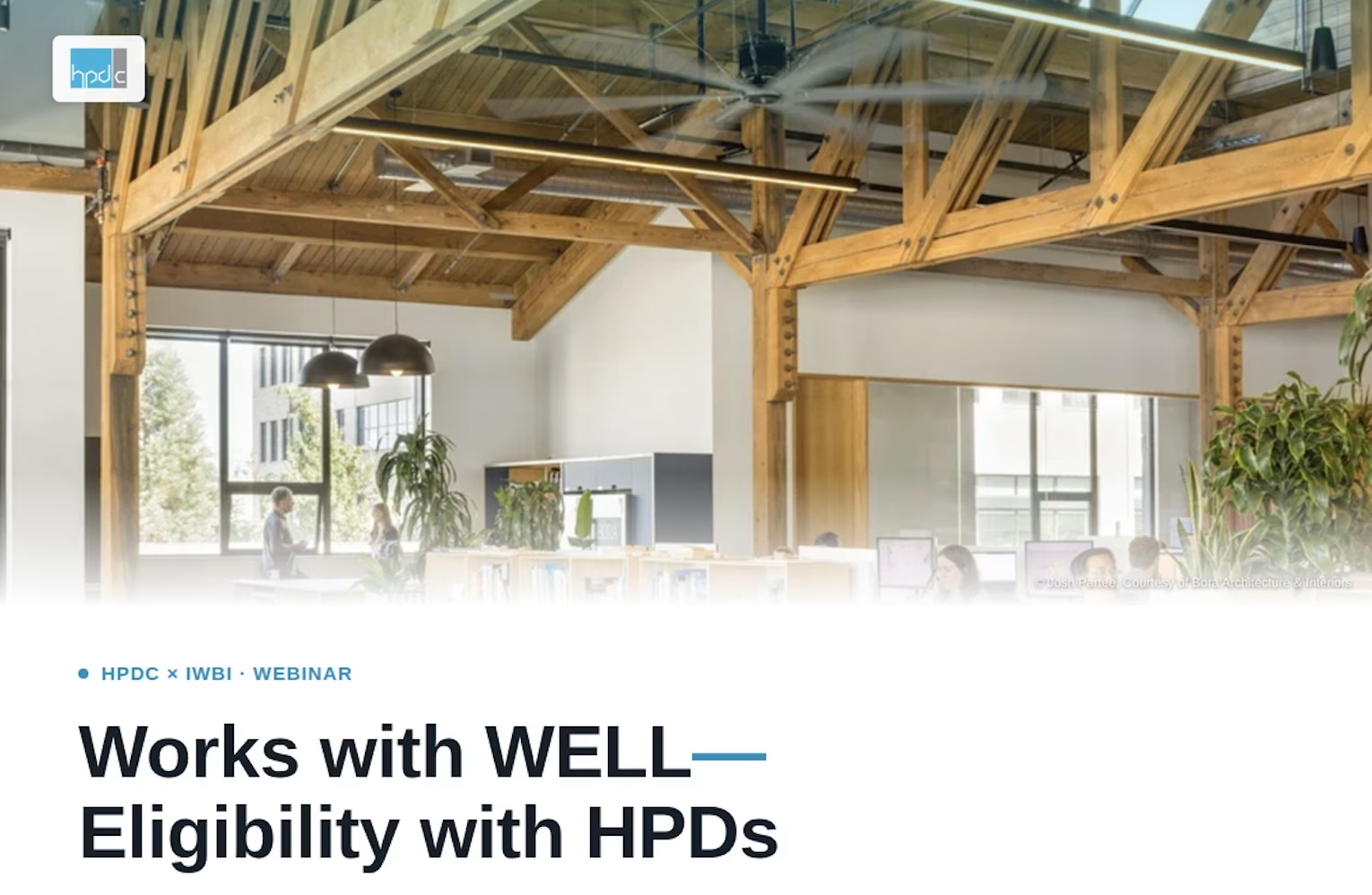
The Works with WELL pre-check is live in HPD Builder. It reads the HPDs you have already published and tells you which WELL features your products align with — no second submission, no re-entered data.

On August 18, HPDC and the International WELL Building Institute hosted a joint session on something that went live earlier this month: a Works with WELL pre-check inside HPD Builder.

The short version is that a manufacturer who has already published an HPD can now open it, run a pre-check, and find out which WELL features that product aligns with. Nothing is re-entered. Nothing is assembled a second time.

Why this matters

More than 1,000 manufacturers have voluntarily published over 18,000 HPDs covering more than 40,000 products. That is a large body of completed disclosure work.

Until now, using it to gain recognition in another program meant starting over — a new form, a new package, the same underlying facts entered again. The cost of transparency was being paid repeatedly, by the companies that had already done the most.

That is the problem this collaboration removes. As Wendy Vittori put it on the call, the goal has always been to make disclosure so affordable and so straightforward that every product can have an HPD and every project team can use it. Work that only counts once works against that.

The collaboration has been a long time coming. Wendy and IWBI’s Rodolfo Perez noted on the call that the two organizations first discussed doing something concrete around 2018 and 2019, and that HPDC and IWBI have been in conversation for essentially the whole of IWBI’s existence. This is the first time it has taken the form of a shared technical process rather than mutual recognition.

What Works with WELL is — and what it is not

This is worth stating plainly, because it is the question we get most.

Works with WELL is a mark, not a product certification. IWBI does not operate a testing laboratory and is not a label competing with the certifiers already in this space. What the mark does is show how a product contributes to WELL strategies — the chemical restrictions, the emissions thresholds, and the disclosure requirements already written into the WELL Building Standard.

Rodolfo made the underlying logic hard to argue with: the first word in HPDC is Health. The first concept in WELL is health. Both organizations are working on the same problem from different ends.

For scale: WELL is in use in more than 12 countries, across roughly six billion square feet.

What the pre-check actually checks

Milla Marcano, HPDC’s Technical Manager, demonstrated it live. Inside HPD Builder, the tab that used to read “LEED and program pre-checks” now reads LEED, WELL and program pre-checks, with a Works with WELL tab alongside the others.

It evaluates your HPD data against the five WELL v2 Materials features that bear on material health:

  • X01, Fundamental Material Precautions — the precondition covering asbestos, mercury, and lead, with lead handled separately for electronics, paints, and plumbing products.
  • X05, Enhanced Material Restrictions — which branches by product category.
  • X06, VOC Restrictions — covering both content and emissions.
  • X07, Materials Transparency — with three paths: a complete HPD at the 1,000 ppm threshold, a complete HPD at 100 ppm, and a third-party verified HPD.
  • X08, Materials Optimization — which looks at ingredients and at certifications relating to material health performance.

Each feature reports alignment with the reasoning attached, so a product that does not align comes back with the specific cause — a substance on a screening list, a category that does not apply — rather than a bare no. Each card links to the underlying feature language in the WELL Building Standard.

One detail worth knowing: a complete, published HPD already aligns you with at least one WELL feature before you check anything else. The disclosure itself is the first contribution.

Where the data goes

The pre-check result is not part of your HPD. It does not appear in the report and it does not render in the PDF.

It is a separate data set, shared with IWBI through HPDC’s API. IWBI uses it to identify manufacturers whose products are candidates for the program. Designations then come back to us, and products that hold one are marked in the HPD Public Repository and surfaced in the dashboard available to HPDC members.

That designation also reaches HPDC’s API data partners — the workflow tools and product libraries where project teams actually specify. Andre Baros of Acelab raised this on the call, and it is the part manufacturers most often miss: publishing does not just place a document in the Repository, it moves the result to where specification decisions get made.

If your HPD covers multiple products, use the SKU field. HPDC’s grouping guidelines let one HPD represent several products where they share at least 90 percent of their inventory, hold common certifications, and are functionally similar. Listing the individual product identifiers is what tells IWBI the alignment covers all of them.

How to get started today

  • Open your product in HPD Builder and go to LEED, WELL and program pre-checks.
  • Select the Works with WELL tab and run the pre-checks that apply to your product.
  • Read the feedback on any feature that does not align. Much of it is addressable.
  • Publish. If the HPD is already published, publish again — that updates the record and sends the pre-check data.
  • Contact IWBI to enroll.

On timing: because the material health claims have already been checked by the pre-check, the remaining review at IWBI is expected to be considerably faster than the program’s normal path.

What comes next

More is being added — an option to run every pre-check at once, clearer reporting on features a product is not eligible for, and a prompt before publication reminding you to run your pre-checks.

If you have not looked at the pre-checks in HPD Builder recently, this is a good moment. There are now three tabs of them covering different programs, and they run together. Alignment work you do for one program is visible against the others in the same place.

Watch the session: https://www.youtube.com/watch?v=4rESfyMI8BU

Milla’s demo begins at about 19 minutes, and the Q&A runs the final twenty.
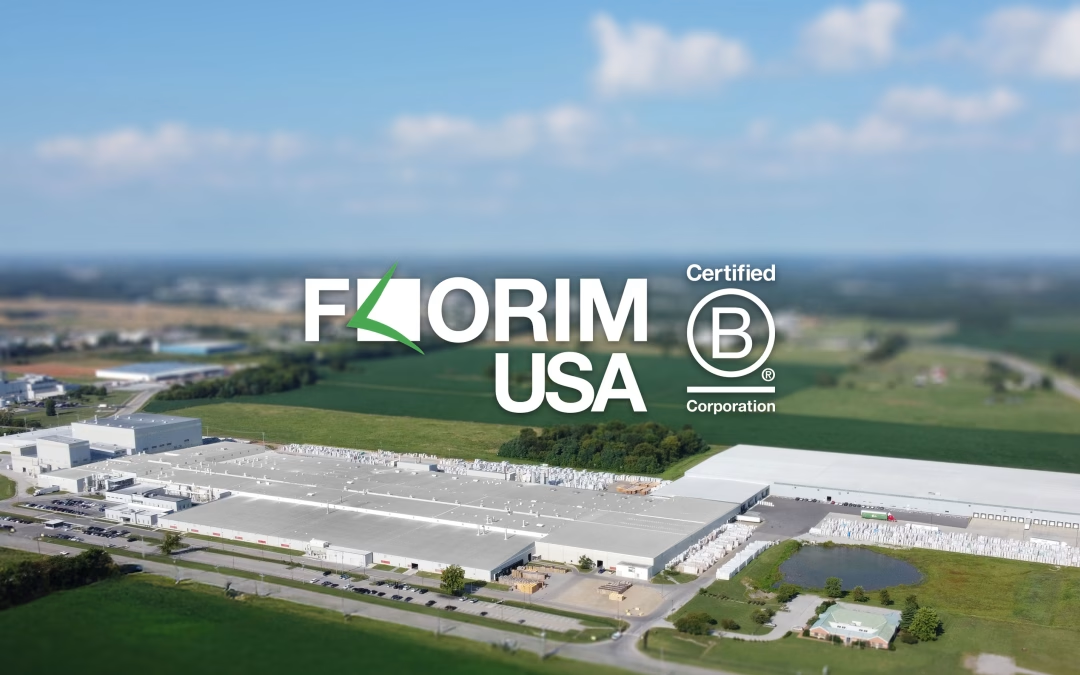
Member Spotlight: Florim USA Leads the Way in Sustainable Porcelain Tile Manufacturing

Member Spotlight: Florim USA Leads the Way in Sustainable Porcelain Tile Manufacturing

Florim USA, based in Clarksville, Tennessee, is one of North America’s largest porcelain tile manufacturers and has proudly produced Made in the USA porcelain tile for more than 25 years. Through its MILE®stone brand, Florim USA serves the United States with products specifically designed for the U.S. market and sold via a nationwide distribution network. Reinforcing its commitment to transparency, accountability, and creating a positive impact, Florim USA became a Benefit Corporation in 2022. In October 2025, Florim USA achieved B Corp certification, joining a global community of businesses that meet rigorous social and environmental performance standards — and setting a new benchmark for responsible manufacturing in the U.S. porcelain tile industry.

In addition to B Corp certification, Florim USA has renewed both its Environmental Product Declarations (EPDs), first earned in 2015, and its Health Product Declarations (HPDs), first earned in 2017. EPDs provide verified, transparent data on the environmental impact of products across their lifecycle, while HPDs disclose the health impacts of product ingredients, helping architects, designers, and builders make informed, health-conscious material selections. Further emphasizing health-conscious design, Florim USA’s products carry Declare Red List Free certification, meaning they contain no hazardous chemicals as identified by the Living Building Challenge. Florim USA is the only U.S. porcelain tile manufacturer to hold both Declare Red List Free certification and B Corp status.

Florim USA’s commitment to sustainable practices is further reinforced by several industry-recognized certifications, including Green Squared, GREENGUARD Gold, and more — demonstrating an ongoing dedication to responsible manufacturing, low-emission products, and environmentally sound sourcing. Florim USA was also the first U.S. porcelain tile manufacturer to produce a Carbon Neutral collection, Plaster 2.0, in 2022; there are now eleven Carbon Neutral collections available.

As the building industry continues to prioritize human health, environmental responsibility, and material transparency, Florim USA remains dedicated to empowering better decisions through verified disclosures. That commitment is why Florim USA is proud to host the HPDC reception during Greenbuild 2026 this October — bringing together sustainability leaders, manufacturers, designers, and building professionals to advance healthier, more sustainable buildings through open and accessible product information.

Documenting LEED v5 BPSP — Your Questions, Answered

Documenting LEED v5 BPSP — Your Questions, Answered

Follow-up Q&A from the HPDC × USGBC webinar, June 17, 2026.

More than 270 of you joined us on June 17 for Documenting LEED v5 BPSP — and you brought outstanding questions, far more than we could answer live. This follow-up collects the most common ones, with answers from USGBC’s Wes Sullens and HPDC’s Wendy Vittori and Milla Marcano. The webinar recording will be shared with all registrants — watch your inbox.

A quick framing note before the questions: LEED v5’s Building Product Selection & Procurement (BPSP) credit rewards products with stronger, multi-attribute transparency. Materials transparency is one of five BPSP criteria areas — it is not a standalone “ingredient” credit anymore. Roughly 90% of the attributes recognized under LEED v4/v4.1 still count; they have simply been reorganized.

Continuing education & GBCI credit

Is this webinar eligible for GBCI continuing-education credit? What’s the Course ID?
Yes — the course is approved for 1 CE hour, and the GBCI Course ID is 0920034934. You self-report through your GBCI account; when you do, enter the course ID number rather than the course title. If you hold LEED AP BD+C, LEED AP ID+C, or LEED Green Associate, these are LEED-specific CE hours; other credentials (such as LEED AP O+M) earn general CE hours.

Access, cost & membership

What does it cost to access the tool? Is an active HPD membership required?
All of the capabilities shown are free to use for registered HPDC Builder users — access is through HPDC membership. For full, unlimited access, affiliate membership is just under $1,000/year. For occasional or limited use, a lower-cost token program is available.

Is there a price for practitioners (architects/specifiers), not just manufacturers?
Practitioners do not need a separate paid tier to use the Builder and scoring tool — access comes with membership (or tokens), the same path described above.

The calculator & criteria resources

Is there a link to the calculator and the criteria/scoring table?
Yes:

The approved-document table is updated roughly every six months through the standard LEED addenda process.

How scoring works

How do material costs factor into the calculation?
For each product category you choose the metric that fits your project — cost, area, or volume — and you can mix metrics across categories.

If a product has an optimized EPD (3), a third-party-verified HPD (2), and a Declare label (1), is its score capped at 5 or summed to 6?
Within a single criteria column you take the highest applicable value, not the sum — there’s no double-counting, and the calculator handles this automatically. The maximum multiplier is 5x.

Why doesn’t post-consumer recycled content score higher than pre-consumer?
It does — this was a typo in the materials shown. Post-consumer is weighted 1x and pre-consumer 0.5x. (Thanks to the attendee who caught it.)

How does the multi-attribute score relate to final LEED points?
There are two distinct tools: (1) the scoring tool inside the HPDC Builder, which computes each product’s multi-attribute score and achievement level (Level 1/2/3, acting as multipliers up to 5x); and (2) the USGBC LEED calculator spreadsheet, where those scores roll up into final LEED points. HPDC supplies the per-criteria score, achievement level, and the scoring-document URL; cost-adjusted value is entered by the project team in the LEED calculator.

Product categories & coverage

Will this apply to products not in the BPSP categories — e.g., network/data cabling, MEP, or structural products?
Yes, through LEED v5 pilot credits in the optional credit library:

How do we document MEP and structural products for the pilot credit when the calculator has no dropdown for those categories?
An updated calculator with that capability is expected to be uploaded as part of the July LEED addenda. A pilot-credit calculator is in final testing.

Will GreenGuard or other low-VOC / low-emission certifications count?
VOC emissions and content are planned as recognized document types but are not collected today — they will be added in a future release as the compliance-library document list expands. (About half the document types are live now; the rest follow, with VOC among the later additions.)

Will polycarbonate skylights fall under the ceilings category, and will cost-adjusted value be included?
Yes — coverage isn’t a problem. Every product category is covered either by the BPSP credit or by the two pilot credits, and HPDs are not filtered by CSI MasterFormat, so any product can score. On cost: cost-adjusted value is entered manually by the project team — the LEED calculator already has a column for it. HPDC supplies the multi-attribute score, achievement level, and scoring-document URL per criteria area; the project team adds the cost figure.

HPDs, documents & eligibility

My published HPD returns “Not eligible product – Nested” in the v5 scoring tool. How do I make my EPDs eligible?
The HPD must be PreCheck for LEED v4.1 or v5. In the live example (Armourcoat Spatulata P70/P80), Milla added the required PreChecks on the spot — republishing the HPD then lets it score. If you hit this, contact HPDC with the product name and we’ll check the PreCheck status.

Do existing HPDs need to be republished to be scored?
No. All published HPDs are scored automatically — there’s no need to republish existing HPDs. (Republishing is only needed after a change, like adding a PreCheck.)

Can the Builder incorporate documentation beyond HPDs — recycled content, take-back/recycling services, etc.?
Yes. Any document type on the criteria/label-guidance table can be added to the product’s compliance library (URL, name, issue/expiry date, unique identifier). About half the document types are live now; the rest follow. Bio-based content is deferred pending USGBC guidance.

What happens when a document expires? Does the Builder automatically pull in renewed certificates?
No automatic renewal. When a certificate is renewed, the manufacturer updates the document and republishes; the update then flows through HPDC’s APIs into the repository. Project teams can also use the “contact manufacturer” feature to request an updated certificate. Expired documents stop scoring once USGBC defines the validity rule for that document type; unexpired documents continue to count. Per Wes: documentation should be valid at the time of purchase/installation, and GBCI allows leeway if a document expires after the building’s certification date.

Data, automation & workflow

Are APIs in the works to connect other databases and automate data upload — rather than only CSV upload?
Yes — APIs already move published data into the repository, and CSV upload is supported today (a unique identifier is required to map documents to products). Further automation is on the roadmap.

How do you export / manage LEED documentation when running multiple projects at once?
The Builder provides per-project download queues/folders: select the products for a given project and download a CSV with the multi-attribute columns pre-filled.

International scope

Are Canadian (and other international) projects, architects, products, and specifiers part of this effort?
Yes — there is strong participation from Canada, Mexico, and South America. An EU version, tuned to EU regulatory requirements, is shipping very soon, and the credit library includes European alternative-compliance-path filters.

What’s next

  • Recording: shared with all registrants — watch your inbox.
  • Publishing capability: rolling out now; existing compliance data mapped shortly after.
  • Project-team tools: a repository dashboard and pre-filled LEED-calculator download are coming, followed by a dedicated project-team webinar.

Questions we couldn’t fully resolve here will be updated as USGBC publishes the July addenda. For product-specific help (PreCheck status, eligibility, scoring), contact HPDC.

Introducing Circularity PreCheck: Connecting HPD Data to the C2C Certified® Pathway

The path to product circularity just became more accessible.

The Health Product Declaration Collaborative (HPDC), in partnership with The Cradle to Cradle Products Innovation Institute (C2CPII), is proud to announce the launch of C2C Certified® Circularity PreCheck—a new capability designed to help manufacturers and project teams take meaningful steps toward circularity using data they already have.

A Smarter Way to Screen for Circularity

Circularity PreCheck allows users to screen Health Product Declaration (HPD) content inventories against the Cradle to Cradle Certified® Products Program Restricted Substances List (RSL) directly within the HPD Builder and HPD Public Repository.

This means no duplicated effort, no starting from scratch—just a more efficient way to leverage existing material health data to evaluate alignment with C2C Certified® requirements.

By streamlining this process, Circularity PreCheck helps reduce barriers that have traditionally made circularity certification more complex and time-consuming.

Two PreCheck Options to Meet Industry Needs

To support a wide range of products and use cases, Circularity PreCheck is available in two versions:

  • C2C Certified® Circularity PreCheck
    Screens for avoidance of organohalogens and other functionally related chemical classes of concern across all product categories.
  • C2C Certified® Circularity PreCheck — Electrical & Electronics
    Includes additional screening aligned with RoHS requirements for electronic products.

Supporting Better Product Selection

Circularity PreCheck doesn’t just benefit manufacturers—it also empowers project teams and C2C assessors.

New Repository Dashboard filters make it easier to identify HPDs that meet Circularity PreCheck criteria, helping teams confidently select products aligned with leading material health standards.

Advancing a Fully Digital Certification Future

This launch reflects a broader shift toward digital, scalable certification systems that meet the needs of today’s built environment.

As Ren DeCherney, Director of the Built Environment at The Cradle to Cradle Products Innovation Institute, explains:

“The Cradle to Cradle Products Innovation Institute is currently fully digitizing the Cradle to Cradle Certified® Products Program, which we believe represents the next generation of rigorous, accessible, and scalable impact.

Partnerships like this one with HPD Collaborative are exactly what accelerate that vision. By connecting HPD’s material health pre-screen tool directly to the C2C Certified® pathway, we’re removing barriers that have historically kept circularity out of reach for too many manufacturers. Good data is the backbone of a circular economy, and this partnership helps build the infrastructure the industry needs to move from linear to circular.”

Join the Launch Webinar

To celebrate the launch, HPDC and C2CPII are hosting a joint webinar on:

March 31st, 2026
11:00 AM ET / 5:00 PM CET

The session will include:

  • Insights on C2C Certified® Version 5 and the future of digital certification
  • A live demonstration of Circularity PreCheck in the HPD Builder and Repository
  • Live Q&A with experts

Registration link: https://events.teams.microsoft.com/event/3d3ea27c-ea67-4945-8ffa-3767b8970f10@e0a253ff-f139-4949-afa7-5eb90e552d6a

Building the Future of Circularity—Together

Circularity PreCheck is more than a new tool—it’s a step toward a more connected, transparent, and efficient materials ecosystem.

By aligning HPD data with the Cradle to Cradle Certified® pathway, this partnership demonstrates what’s possible when industry leaders work together to reduce complexity and accelerate progress toward a circular economy.

Winter 2025 Thoughts from our Board Chair

Mike Manzi

I’ve been struggling a bit to come up with this quarter’s “Thoughts….” I knew I wanted to neatly explain why HPDC is so important and the primary focus of my extracurricular energies for the last decade and a half. Then, this morning, a coworker said he’d heard on the radio that cancer risks in “Cancer Alley” – that 85-mile stretch of petrochemical plants from New Orleans to Baton Rouge – are 7 times higher than the national average. This led me to new research using mobile labs to measure air pollution throughout this region that says we’re significantly underestimating that risk.

As we’ve known since Rachel Carson’s time, the beneficiaries of polluting industries and their government enablers bank on narrow data that assumes otherwise completely healthy people are subjected to just one toxin at a time, so no harm is done as long as we keep that below some magical threshold. This is ridiculous, of course, because we’re all subject to many toxins in the air, soil, and water. This is compounded with devastating effects on those unfortunate souls, maybe living in family homes predating the chemical plants and without the financial capacity to simply pack up and move, who send their children to school hundreds of feet from these facilities.

This is certainly not new information to me, but serves as a succinct reminder that my reasons are not complicated. Chemical companies and governments will not protect us, especially the most vulnerable. But those of us making decisions about what we build with have the power to do something. We long ago realized that only with adequate knowledge can we make decisions, as manufacturers, builders, designers, and owners, that avoid the worst effects and drive change towards healthier outcomes for everyone.

Providing this information for every building product is HPDC’s purpose. With HPDs covering tens of thousands of products, we’ve come a long way. We have much more to do; to enhance what we know about some products and learn what we still don’t know about others, to reach further down the supply chain, to reduce the number of chemical unknowns, and to understand how to make better choices with this information.

We bank on the broad notion that enough of us care to create a world where the benefits of some do not cause the suffering of others. HPDC, with “Collaborative” very intentionally in our name, knows we can’t do this alone. Our board, technical committee, and technical subgroups have provided the primary forums for representatives from across the material health ecosystem to sort out the many nuances of collecting and using this information. With equal intention we’ve kept HPDs free to access and inexpensive to generate.

Having well established methods for collecting health information, we are expanding the Builder to cover the full breadth of the Common Materials Framework, AIA Materials Pledge, and LEED v5 Materials Credit. We will be sharing the importance of material transparency beyond the commercial building sector. And, our ecosystem partners are becoming more sophisticated in their capabilities to make this information actionable to project teams, manufacturers, and researchers.

So, my message is simply this: In the drive to eliminate the need for toxic chemistry, HPDC plays a central role. If you haven’t already, please join us.

Identifying the hidden threats that surround us

In the developed world, people typically spend up to 90% of their lifetime indoors, thus making the indoor environment central to their well-being. However, these indoor environments are often laden with hazardous chemicals, exposure to which over an extended period may lead to a myriad of health effects resulting in lost workdays and severe economic ramifications.

In my recent exploration of formaldehyde in the built environment (Carcinogenic formaldehyde in U.S. residential buildings: Mass inventories, human health impacts, and associated healthcare costs), the Health Product Declaration Collaborative (HPDC) public repository emerged as a crucial resource facilitating material transparency. Housing over 10,000 published health product declarations (HPDs) the HPDC public repository’s significance lies not just in its ability to inform individual products, but in its power to illustrate in great details the chemistry of our built environment, accelerating our understanding of exposure to chemical hazards like formaldehyde.

Prior to the HPD Open Standards, navigating the chemical composition of building materials was analogous to deciphering a cryptic code. The HPD open standards revolutionized this landscape by establishing a standardized format for ingredient disclosure. This transparency allowed researchers like me to dissect the material makeup of our buildings, identifying potential chemical hazards and uncovering trends in their use while correlating these chemicals to a myriad of health effects which could be the cause of extended exposure.

This newfound transparency unlocks the potential for a paradigm shift in our understanding of chemical exposure. A future where researchers leverage the HPDC database to conduct large-scale studies, analyzing material use across diverse building types and geographic regions, is not far away. Such insights could inform the development of safer materials and guide the creation of health-focused regulations for the built environment.

In essence, the HPD database is a transformative tool, demystifying the chemical composition of our built environment. By facilitating transparency and enabling robust data analysis, the HPD open standards has the potential to revolutionize how we design, construct, and ultimately, experience the spaces we inhabit. The more we leverage this resource, the sooner we can create buildings that prioritize the health and well-being of their occupants.